

Shredder Machines
Your Professional Shredder Machines Supplier
Wisdom Ring Machinery is a professional manufacturer of scrap recycling equipment. We provide copper recycling machines, shredders, balers, metal shears, tire recycling lines, and plastic recycling equipment for customers in recycling, waste processing, and metal recovery industries worldwide.
Experienced Manufacturing
With over 30 years of industry experience, we focus on stable machine performance, practical design, and long-term operation for industrial recycling applications.
Strong Technical Team
Our team includes 15 engineers dedicated to product development and technical improvement, helping customers achieve efficient and reliable recycling processes.
Complete Customer Support
We provide complete service from machine selection and production to installation and after-sales support, ensuring smooth communication and dependable cooperation.
-
 Double Shaft Metal ShredderFeaturing a dual-shaft blade design, it is also known as a dual-shaft shredder. It is specifically designed for processing a variety of materials, especially suitable for initial volume reduction. ItAdd to Inquiry
 -
 Heavy-Duty Dual Shaft ShredderPurpose-Built for Metal: Not a modified waste shredder. Every component is selected and engineered for the unique stresses of metal processing.Superior Output Quality: The shearing action createsAdd to Inquiry
 -
 Dual Shaft Tire ShredderUnmatched Power & Reliability: The independent drive system is the most robust configuration available, ensuring consistent performance under shock loads and in continuous operation.OperationalAdd to Inquiry
 -
 Single Shaft Industrial ShreddersHigh-Torque, Low-Speed Rotor SystemHydraulic Pusher Ram with Smart ControlModular Cutting Chamber & Easy-Maintenance DesignCE-Certified Safety & Intelligent Control SystemAdd to Inquiry
 -
 Single Shaft Shredder MachineProven Technology for European Waste Streams: Engineered specifically for the composition and regulations governing European solid waste.Emphasis on Safety & Compliance: Designed and documented forAdd to Inquiry


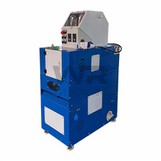

Parameter
|
Model |
Feed inlet |
Dimensions |
Weight |
Power |
|
W-EB180 |
180*190mm |
722*300*590mm |
120kg |
1.5kw |
|
W-EB300 |
500*500mm |
1081*570*1329mm |
400kg |
3kw |
|
W-EB400 |
600*500mm |
1160*600*1450mm |
500kg |
5.5kw |
|
W-EB500 |
700*700mm |
1350*700*1600mm |
750kg |
7.5kw |

The shredder machines produced by our company mainly include the following types:
Single Shaft Shredders
Single Shaft Industrial Shredders is an industrial-grade crushing device that uses a single rotating main shaft equipped with movable blades (or hook blades) combined with a fixed bottom blade (fixed blade) to shear, tear, and compress materials, thereby reducing the size of large, hard solid waste.
Double Shaft Shredders
Double Shaft Metal Shredder is the essential, no-fuss tool for electricians, technicians, hobbyists, and anyone who demands quick, clean, and precise wire stripping. Designed for portability and ease of use, this compact tool delivers reliable performance right in the palm of your hand, eliminating the need for power sources or complex setups.
Advantages of Shredder Machines
Volume Reduction and Storage Savings
For recycling facilities operating with limited floor space, volume reduction through shredding can free up significant operational capacity. Storing shredded or chipped material is also generally safer and more manageable than storing bulky whole items like tires, white goods, or pallets.
Reduced Transportation Costs
Shredded material is denser and more uniform than unprocessed waste, which means more material fits into each transport load. Reducing the number of vehicle movements required has a direct impact on fuel costs, driver time, and vehicle wear.
Improved Sorting and Separation
Shredded material is easier to sort mechanically. Eddy current separators, magnetic separators, and air classifiers all work more effectively on material that has been reduced to a consistent particle size. This is particularly relevant for mixed waste streams containing metals, where shredding is a prerequisite for effective ferrous and non-ferrous separation.
Preparation for Downstream Processing
Shredded material is physically compatible with a wider range of downstream processes than whole or bulky waste. Shredded plastic can be fed directly into extruders or pelletizers. Shredded rubber can be processed through granulators to crumb rubber specification. Shredded paper can be pulped more efficiently.
Contribution to Circular Economy Goals
Recycling businesses play a central role in the transition to a circular economy, where materials are kept in productive use rather than being landfilled or incinerated. Industrial shredders directly support this by making a wider range of materials processable and recoverable.
Applications of Shredder Machines
Construction and Demolition (C&D) Waste
Processing materials like wood, concrete, drywall, and asphalt for easier hauling and recycling.
Scrap Metal Processing
Reducing scrap steel, aluminum, and copper for transport or further processing. Shredders help achieve consistent particle sizes that make sorting and resale more efficient.
Municipal Solid Waste (MSW)
Reducing bulky household and industrial waste to lower landfill volume and prepare for separation of recyclables.
Plastic and Rubber Recycling
Preprocessing plastic drums, film, or rubber tires before granulation.
Green Waste and Biomass
Turning branches, pallets, or yard waste into mulch or biomass fuel. High-torque shredders can handle wet and fibrous materials that would clog smaller grinders.
Electronics and Data Destruction
Quad-shaft shredders or high-security shredding systems are used to destroy sensitive electronics, hard drives, and other materials requiring complete data destruction.
Installation Steps for Shredder Machines
Assembly
The assembly process of an industrial shredder can be complex and varies depending on the model and type of the shredder. It is highly recommended to follow the detailed assembly instructions provided in the manual.
Base Installation
Start by installing the base of the shredder on the prepared site. Use leveling tools to ensure that the base is perfectly level. Secure the base to the floor using bolts or other appropriate fasteners. This will provide a stable foundation for the rest of the shredder components.
Blade Installation
Install the shredder blades carefully. The blades are the most critical part of the shredder, and their proper installation is essential for efficient shredding. Make sure the blades are sharp and properly aligned. Follow the instructions to tighten the blade bolts to the specified torque.
Motor and Drive System Installation
Connect the motor and the drive system to the shredder. This includes installing belts, pulleys, and couplings. Ensure that the belts are properly tensioned to prevent slipping. Check the alignment of the motor and the drive system to ensure smooth operation.
Control Panel Installation
Install the control panel in a convenient location near the shredder. Connect all the electrical wires from the control panel to the various components of the shredder, such as the motor, sensors, and switches. Test the control panel to ensure that all the functions are working correctly.
Safety Precautions for Shredder Machines Operations
All industrial shredders should be fitted with appropriate guarding over the cutting chamber, infeed zones, and discharge areas. Access to the cutting chamber during operation should be physically prevented by interlocked guards, not just procedural controls.
Emergency stop functions should be clearly marked, easily accessible from the operating position, and tested regularly. For automated or remote-operated shredding lines, emergency stop systems should be present at multiple points along the line, not just at the main control panel.
Shredding operations generate dust and noise, both of which present health risks to workers in the vicinity. Dust extraction systems should be specified as part of the shredder installation, particularly for operations processing dry materials like paper, wood, or rubber powder.
Certain materials processed in shredders present fire risk, particularly materials with residual fuel or flammable content. Shredding of electronic waste, batteries, or materials contaminated with flammable substances requires specific risk assessment and appropriate fire suppression provisions.
Inquiry
Quotation
Communication
Order confirming
Deposit payment
Production
Testing and debugging
Balance payment
Packing
Delivery
Customer receiving
After service
Packaging and Shipping
|
Packaging |
Inner package: Covered by plastic film Outter package: Plywood case |
|
Shipping |
By sea |
FAQ
As one of the leading shredder machines manufacturers and suppliers in China, we warmly welcome you to buy advanced shredder machines for sale here from our factory. All customized machines are with high quality and competitive price. Contact us for quotation.
